Model Context Protocol (MCP)
From version 0.122.0
The Model Context Protocol (MCP) is an open protocol that enables the integration of LLM Agents with external tools and data sources.
The following shows how the Arc Framework running in Spring Boot can be configured to utilize MCP.
The Arc Framework makes use of the MCP in the following ways:
- Integrates MPC hosted tools seamlessly into Arc Agents.
- Enables the pulling of prompts from MCP enabled servers.
- Exposes Arc Functions as MCP tools.
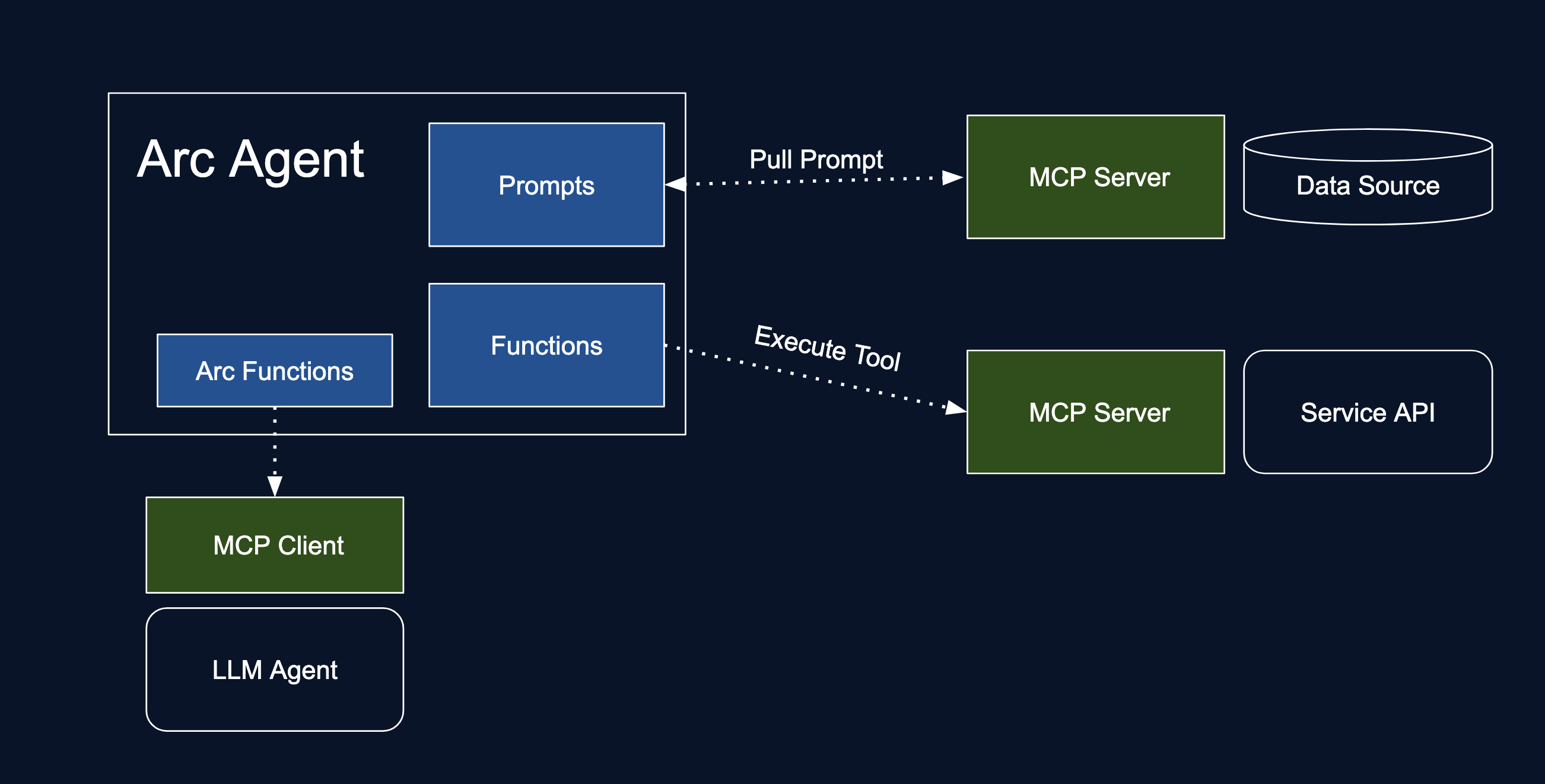
Consuming MCP Tools
Integrating MCP tools into your Arc Agent is as simple as adding the following configuration to your application.yml file:
  mcp:
    tools:
      urls: [MCP_TOOL_SERVER]
One or more MCP tool servers can be specified in the urls list.
After that tools can be referenced in Agents the same as if they were local tools.
agent {
    name = "weather"
    description = "Agent that provides weather data."
    prompt { """ Some system prompt """ }
    tools {
        +"get_weather"
        +"get_time"
    }
}
Arc as a MCP Server
Arc can also function as a MCP server, exposing its tools to other agents. A pre-requisite for this is that Arc is running in Spring Boot server and the Arc Spring Boot Starter is included in the project.
Once that is set up, simply enable the feature by adding the following configuration to your application.yml file:
arc:
  mcp:
    tools:
      expose: true
and add the Spring Boot MCP library to your project:
implementation("org.springframework.ai:spring-ai-mcp-server-webmvc-spring-boot-starter:1.0.0-M6")
See https://docs.spring.io/spring-ai/reference/api/mcp/mcp-server-boot-starter-docs.html#_webflux_server_configuration for some configuration options.
Error Handling with McpToolErrorHandler
Starting from version 0.122.0, the MCP configuration supports integration of a custom error handler for tool calls.
The McpToolErrorHandler interface allows you to handle errors that occur during a tool call and return custom error messages.
Example integration:
@Bean
fun myErrorHandler(): McpToolErrorHandler = object : McpToolErrorHandler {
    override fun handleToolError(toolName: String, error: Exception): McpSchema.CallToolResult? {
        // Custom error handling, e.g. logging or specific error message
        return McpSchema.CallToolResult("Error in tool $toolName: ${error.message}", true)
    }
}
When an error occurs during a tool call, the system first checks if an error handler is present.#
If so, its handleToolError method is called. If it returns null, the default error handling is used.