June 01-04 • Berlin-Adlershof, Germany
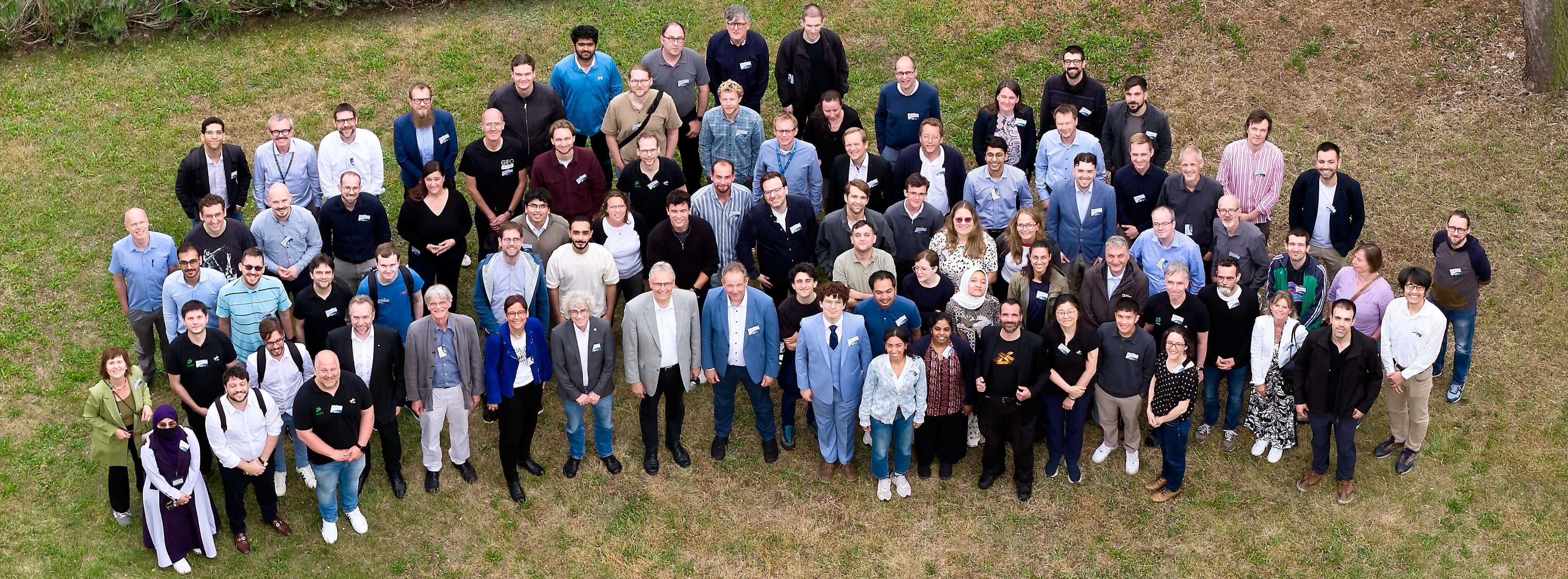
Proceedings
Conference Proceedings: https://www.tib-op.org/ojs/index.php/scp/issue/view/205
DOI: https://doi.org/10.52825/scp.v7i
Sessions and Presentations
Tutorial
Tutorial files Video TranscriptionKeynote: Traffic simulation modeling: combining generative modeling with transportation science to achieve scalability - Prof. Dr. Carolina Osorio
VideoKeynote: SUMO and I – 25 years later… - Prof. Dr. Peter Wagner
Video
Session 1
- sumoITScontrol
Kevin Riehl, Anastasios Kouvelas and Michail A. Makridis
Video Preprint - VRU-Aware GLOSA: Integrating VRUs into Green Light Optimized Speed Advisory for Right-Turn Conflicts at Signalized Intersections
Pushkar Mahajan, Anna-Lena Schlamp and Stefanie Schmidtner
Video Preprint - Radar-Based Evaluation of Car-Following Behavior and Fuel Consumption Across Vehicle Categories in SUMO
Joshua Bittle and Mahdi Al Abdraboh
Video Preprint
Session 2
- Enabling Non-Lane-Based Cycling Behavior for Mass Bicycle Traffic Flow Simulation in SUMO
Ying-Chuan Ni, Thomas Ramseier, Junzhe Cao, Anastasios Kouvelas and Michail Makridis
Video Preprint - A Cycle-Level Distribution-Based Calibration of Microscopic Intersection Models Using UAV Trajectories
Charalambos Tsioutis, Konstantinos Pourgourides and Stelios Timotheou
Video Preprint
Session 3
- Improving SUMO for Motorcycles
Gnanambica Chouta and Christian Facchi - Framework for Generating Activity-Based Travel Demand Using Aggregated Mobility and Land-Use Big Data
Joerg Schweizer, Ngoc-An Nguyen, Cristian Poliziani and Federico Rupi
Video Preprint - A Dynamic Traffic Calibration Framework for SUMO Based on Historical Real-World Speed Data
Finn Guist, Andreas Freymann, Sandro Lipinski, Emanuel Reichsöllner and Mirko Sonntag
Video Preprint
Session 4
- Integrating Synthetic Populations and Activity Chains for Individual Emission Assessment in SUMO
Alix NGARI LENDOYE, Corwin Fèvre, Tatiana Graindorge and Alain Bouju
Video Preprint - Reconstruction of Public Transport Routes Based on Imperfect GTFS and OpenStreetMap Data
Alexander Kaiser and Alexander Schmaus
Video Preprint - Energy- and Emission-Conscious Extension of TAPAS-SUMO Coupling - A Case Study in Delmenhorst
Yun-Pang Flötteröd, Michael Behrisch and Knut M. Heidemann
Video Preprint
Session 5
- C-ITS services for light rail systems
Paula von der Heide
Video Preprint - GROSS: German Rail Open-Source SUMO Scenario
Juri Penell and Damian Dailisan
Video Preprint - SUMO for Railway Applications
Christian Rahmig, Jakob Erdmann, Jakob Geischberger and Larissa Zhuchyi
Video Preprint
Session 6
- Energy Optimized Green Light Assist in Varying Traffic Scenarios Using Reinforcement Learning
Johan Kolms, Kai M. Blum, Michael Than, Tamás Kurczveil and Dirk J. Lehmann
Video Preprint - EfaSim - A Prototype for a SUMO-driven Emergency Vehicle Driving Simulator
Rebecca Ahmed, Cristian Cubides-Herrera, Fabian Schuhmann and Markus Lienkamp
Video Preprint - Driver Models in SUMO and Elsewhere
Peter Wagner
Video Preprint
Session 7
- Simulation of DACH-Style Detector-Actuated Traffic Signal Control in SUMO
Markus Runhao Zhou, Johann Krüger and Meng Wang
Video - ATSUM: An Attlas-SUMO Middleware
Rodolfo Valentim, Tiago Pinheiro, Vincen Santaella, Artur Souza, João Cleverales, Fernando Martinelli and Víctor Martínez
Video Preprint - Investigating Traffic Effects of Control Transitions in Level 3 Conditional Driving with SUMO
Robert Alms and Peter Wagner
Video Preprint
Session 8
- Reproducing Weekly Crash Patterns Using a Minimalist Driver Error Model
Ronald Nippold, Andreas Leich and Peter Wagner
Video Preprint - Towards Smarter Intersections Through Digital Twins - The Coupling of SUMO and SCENIMINI
Lars Klitzke, Yun-Pang Flötteröd and Peter Wagner
Video Preprint
Poster Session 1
- Poster Modelling approach for cargo bikes in rural areas as logistic carriers - Isabel Bruns
- Poster Smart Urban Mobility Simulation: A Case Study of Hradec Králové - Michal Michna, Jan Hladěna, Kamila Štekerová, Pavel Čech
- Poster Integrating Elevation Data in SUMO models for detailed estimation of Energy consumption by Electric Vehicle in large networks - Francesco Deflorio, Matteo Ferraro, Giuseppe Calcagno, Amirehsan Charlang Bakhtyari, Lorenzo Sica, Angela Carboni
- Poster Towards Empathic Vehicles: Simulator-Based Induction of Affective States for Emotion Recognition - Niklas Fraissl et al.
- Poster A Multi-Scenario Simulation Approach for Climate-Neutral Urban Corridors - Evangelos Mintsis, S. Kontorinis, V. Mizaras, E. Mitsakis, G. Ayfantopoulou
- Poster Instantania, the fast, parallelized traffic microsimulator for large scale transport digital twins - Joerg Schweizer, Benyamin Heidary
- Poster Bridging Communities: Advancing JuPedSim for Pedestrian Dynamics and Urban Mobility Research - Jette Degenhardt, Mohcine Chraibi and Ralf Leibold
- Sustainable Routing for Next-Generation Mobility: Linking Evolutionary Game Theory and SUMO - Andrea Bertolini, Lorenzo Castelli
- Poster Testing Adaptive Lane-Change Planners in Realistic Traffic: A Co-Simulation Framework using SUMO, Simulink, and RoadRunner - Philipp Hafemann, Anusha Ailuri, Surya Talluri, Simone Hämmerle, Naga Pemmaraju
- Poster Environmental Impact Analysis for a New Urban Development - Aya Aly, Paulo Moura
- Network Performance Analysis of Car-Following Models and Traffic Signal Light Configurations using SUMO - Arya Karnik, Mounika Raj Kavadi, Joshua Bittle
- Poster Analysis and comparison of Multimodal Link Transmission Model and SUMO in urban networks - Ning Xie, Meng Wang
- KISLEK - KI zur Steuerung verbundener Verkehrsknoten - Lukas Klein
- Poster Revisiting Mesoscopic Traffic Flow Simulation in SUMO: Limitations, Analysis, and an Alternative - Ying-Chuan Ni, Alina Akopian, Anastasios Kouvelas, Michail A. Makridis
- Poster QI-TraSiCo – Quantum-Inspired Traffic Signal Control - Elisabeth Wagner et al.
Poster Session 2
- Poster Coupling Vessel Operations and Hinterland Traffic with SUMO and PySeidon - Franck Majeste Silatsa Dogmo, Jordan Guimfack Jeuna, Junior Lesage Ekane Njoh, Laura Bieker-Walz, Lennart Steffen, Nelly Lesly Matchio Kuete, Rima Mkhalalati, Vanelle Leslie Ngeufa Leumalieu, Zidane Kenfack Fouape, Johannes Heidtmann, Philipp Schur
- Poster Towards Adaptive Traffic Pattern Clustering Reinforcement Learning in Traffic Signal Control - Lukas Klein
- Poster Integrating Macroscopic and Microscopic Road Traffic Simulations for Impact Assessment of Flood-Related Disruptions - Amirehsan Charlang Bakhtyari, Francesco Deflorio, Matteo Ferraro, Michele Amaddii, Fabio Castelli, Chiara Arrighi
- Poster Systematic Integration of Heterogeneous Urban Demand Data into a Microscopic SUMO Simulation - Mario Ilic, Niklas Gritsch, Prof. Dr.-Ing. Klaus Bogenberger
- Poster Coordinate-based Lane-Specific Detector Map Matching in SUMO - Niklas Gritsch, Mario Ilic, Prof. Dr.-Ing. Klaus Bogenberger
- Poster Realistic and Scalable Floating Car Observer Detection in SUMO Derived from Co-Simulation - Jeremias Gerner, Klaus Bogenberger, and Stefanie Schmidtner
- Poster BikeZ-ETH: Mass bicycle traffic flow simulation API and cycling trajectory dataset - Thomas Ramseier, Ying-Chuan Ni, Shaimaa K. El-Baklish, Kevin Riehl, Anastasios Kouvelas, Michail A. Makridis
- Poster LLM-Driven Agents for Evacuation Simulation in SUMO - Michael Jones
- Poster Simulation of Unknown Motion - Marius Dupuis, Andreas Richter
- Poster How much do emissions differ? Testing three calculation methods - Addina Shafiyya Ediansjah, Jens Borken-Kleefeld, Meng Wang
- Poster Multi-modal safety-optimized traffic management system using incident-informed rerouting and adaptive signal control: a SUMO application - Dimitrios Tsitsokas, Georgios Matsioris, Emmanouil Barmpounakis, Ioannis Papamichail, Nikolas Geroliminis
- Poster sumo3Dviz - A three dimensional traffic visualisation - Kevin Riehl, Julius Schlapbach, Anastasios Kouvelas, Michail Makridis
- Toward an Agentic AI Framework for Integrated MATSim-SUMO Policy Evaluation - David Micallef, Luca Bondin, Alexiei Dingli
- Poster SESAM: Mobility Simulations in the Cloud - Robert Hilbrich, Angelo Banse
- Causality-Aware Energy Forecasting and Adaptive Task Control in Edge-Assisted Autonomous Vehicular Networks - Maha Alruwaili
Keynotes
Traffic simulation modeling: combining generative modeling with transportation science to achieve scalability
Prof. Dr. Carolina Osorio
Staff Research Scientist, Google ResearchFull Professor, HEC Montreal
Website
This talk presents physics-informed machine learning methods to search high-dimensional continuous spaces in a sample efficient way, with a focus on urban mobility applications. We discuss how the design of variance reduction methods for gradient estimation of generative models can accelerate convergence and robustify model training. We present how standard transportation science metrics can be used to perform physics-informed dimensionality reduction, enabling a more efficient search of high-dimensional spaces. We discuss recent advances in the use of macroscopic traffic models as metamodels for the design of digital urban mobility twins. Methods will be illustrated with case studies of various metropolitan areas. Finally, we identify research opportunities and challenges in the fields of simulation-based optimization and machine learning as applied to urban mobility problems.
About the Speaker
Osorio is a Full Professor at HEC Montreal, where Osorio holds the SCALE AI Research Chair in Artificial Intelligence for Urban Mobility and Logistics. Osorio is also a Staff Research Scientist at Google Research, where Osorio is research lead of Mobility AI. Prior to joining HEC Montreal, Osorio was a faculty at MIT for 9 years. Osorio has consulted for Alphabet's Sidewalk Labs, and has collaborated with top private and public sector, transportation and supply chain stakeholders, including Zipcar, Ford Motor Company, New York City Department of Transportation, and the San Diego planning agency SANDAG. Her research focuses on the design of ML and simulation-based optimization algorithms to tackle high-dimensional transportation problems. Osorio was recognized as an outstanding early-career engineer in the US by the National Academy of Engineering's EU-US Frontiers of Engineering Symposium, is the recipient of an MIT Technology Review EmTech Colombia TR35 Award and was on the GOOD 100 list of innovators in the category of "Minds That Are Hacking Our Surroundings for the Better". Since 2022, Osorio has been ranked yearly in the top 2% of the most cited scientists in the field of Operations Research, Transportation and Logistics.SUMO and I – 25 years later...
Prof. Dr. Peter Wagner
Institute of Transportation SystemsGerman Aerospace Center (DLR)
Website
This contribution begins with a brief and biased account of the origins of SUMO. Given perceived current challenges in microscopic modelling, particularly with regard to the author‘s current favorite topic of traffic safety, it outlines potential future developments centered on modelling rather than usage.
About the Speaker
Being a physicists by training, I have worked in transport for over 30 years, focusing strongly on modelling and simulation. I started out working with cellular automata as traffic simulation tools, but I have also touched most of the pillars of the 4-step algorithm, i.e. on travel demand, traffic assignment, traffic signal control, and assessment (mostly emissions). Recently, I have developed a strong focus on traffic safety, which strongly resonates with modelling and a bit of simulation, but even more so with data analysis. While I have written some papers myself, I have done more work reviewing and improving the work of others, including the students of my classes at TU Berlin and elsewhere.Workshops
During the conference, a series of workshops will take place in dedicated rooms alongside the main program. These sessions offer participants the opportunity to engage more deeply with specific topics in a smaller, interactive setting.
W1 Simulating Connected and Automated Mobility
Monday June 01, 15:30 - 17:30Confirmed participation from DLR Institute of Transportation Systems, University of Trento, FZI Research Center for Information Technology
Connected and Automated Mobility (CAM) relies on advanced and interoperable simulation frameworks to evaluate communication, cooperation, and automated driving functions in realistic traffic scenarios. This workshop presents current developments and applications based on Eclipse MOSAIC, Eclipse SUMO, Eclipse ADORe, as well as specialized CAM use cases implemented with SUMO’s libtraci interface. Short impulse talks and live demonstrations by tool developers provide practical insights into architectures, coupling strategies, and communication modeling (e.g., CAMs/CPMs, platooning). The session is designed to stimulate exchange between developers and users and to discuss integration strategies and future directions for CAM simulation toolchains.
Agenda
| PLEXE and other tools Michele Segata (University of Trento) |
| Eclipse ADORe Matthias Nichting (DLR) |
| SUMO Coupling Mihai Kocsis (FZI) |
| Simulating CAMs / CPMs with SUMO & Libtraci Daniel Wesemeyer (DLR) |
| MOSAIC Demo and BeST Scenario Karl Schrab |
| Discussions |
W2 Using SUMO for simulating innovative public transportation systems + Using SUMO for Railway simulations + Navigating Complexity: Leveraging SUMO for Traffic Planning at Major Events
Thursday June 04, 09:00 - 12:00Confirmed participation from Accurate, DLR Institute of Transportation Systems, Forschungszentrum Jülich, University of Wuppertal, University of Regensburg
Traffic simulation serves as a critical tool for convincing technical experts and communities to pursue different paths in enhancing public transportation systems. SUMO supports this mission with the ability to model rail, road, and water-based transportation modes, importing existing networks and schedules while allowing flexible editing. The resulting simulations capture the complete trip chain of passengers, revealing bottlenecks and accumulating delays caused by congestion on roads as well as on train platforms, and exploring strategies to mitigate them.
SUMO further supports signal infrastructure models, train dynamics, and automated operational response mechanisms such as overtaking, track changes, and stop cancellations. This workshop aims to evaluate the strengths and limitations of SUMO’s current features in the context of railway research, strategic planning, and operational decision-making. Participants will discuss which new modes still require better coverage and how existing capabilities align with emerging simulation needs.
Large-scale events create complex interactions between vehicular traffic and pedestrian flows that require holistic planning tools. This workshop also explores the added value of coupling SUMO with JuPedSim to simulate both road networks and crowd dynamics simultaneously. We will discuss specific needs, data requirements, and pitfalls faced by authorities, event organizers, and transport providers in this context. Through interactive discussion, participants will collaboratively define best practices for using multi-modal simulation in approval workflows and operational planning.
Agenda
| Selective overview on existing rail transport simulations TH Wildau |
| How to simulate the Berlin S-Bahn-Ring including passenger induced delays DLR |
| PodCars as next generation public transport system 4Dialog |
| SUMO scenarios in Berlin public transport BVG |
| RailML and beyond DLR, railML.org |
| Discussions |
W3 Digital Twins and Traffic Management in Cities
Tuesday June 02, 14:30 - 17:30Confirmed participation from BearingPoint, Berliner Wasserbetriebe, City of Bratislava, Eclipse Foundation, Forschungsinstitut für Kraftfahrwesen und Fahrzeugmotoren Stuttgart (FKFS), Infrest GmbH, City of Mannheim, City of München, City of Ulm, Schlothauer & Wauer, Tracasa Instrumental, Transcality
This 2-hour workshop explores the potential of Digital Twins in urban traffic management. Participants will learn how real-time data integration and simulation models enable more adaptive, data-driven mobility systems. Interactive demonstrations highlight smart city case studies that use Digital Twins to optimise traffic flow, reduce environmental impact, and enhance safety. The session concludes with a discussion on technical challenges, scalability, and future directions within the SUMO ecosystem - defining practical next steps for intelligent urban mobility.
Agenda
| Block 1: Public Entitites |
|---|
| City of Bratislava |
| City of Ulm |
| Tracasa Instrumental |
| BVG |
| Berliner Wasserbetriebe |
| Uni Mannheim |
| Block 2: Solution Providers & Research |
|---|
| Eclipse Foundation |
| Forschungsinstitut für Kraftfahrwesen und Fahrzeugmotoren Stuttgart (FKFS) |
| atSTAKE |
| Bearing Point + Robert Alms (DLR) |
| Schlothauer & Wauer |
| Transcality |
| Kentyou |
| co4e GmbH - SESAM: Mobility Simulations in the Cloud |
| Discussions |
|---|
Social Event

Boat Tour
Monday June 01, 18:15 - 21:00We'll set off from Ernst-Ruska-Ufer and navigate the Teltowkanal, Dahme, and Müggelspree, arriving at the Müggelsee - Berlin's largest lake. After spending some time on the lake, the journey will then loop back to our original starting point.
Food & Drinks: Complimentary finger food will be provided. Please note that drinks must be paid for individually, and only cash payments are accepted.
Language
The conference language is English.
Venue
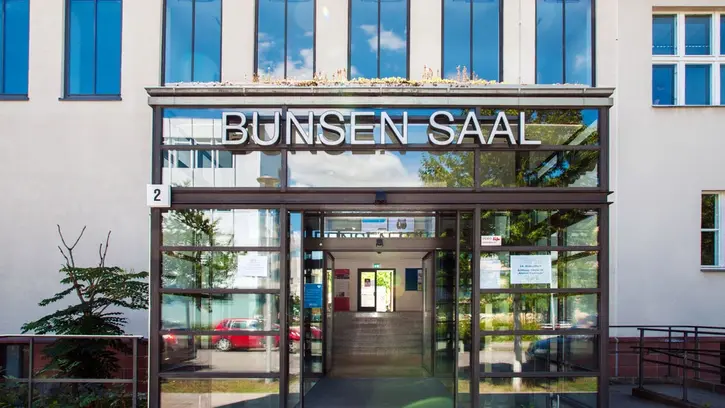
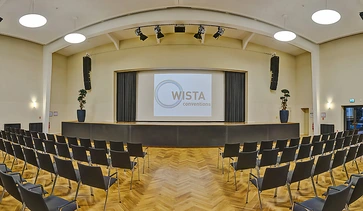
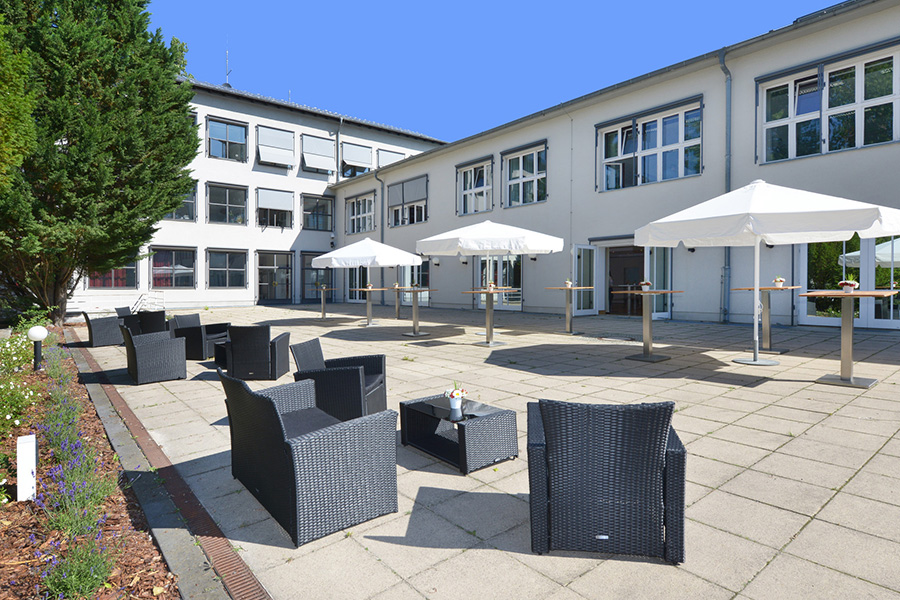
WISTA Event Center - “Bunsen-Saal” Website
Volmerstraße 2
12489 Berlin
Germany
Contact
For questions or comments, please contact the conference team at sumo-conference@dlr.de.