SW360 Architecture
SW360 Architecture Documentation
Version: 1.0
Date: March 2026
Classification: Public
Document Information
| Attribute | Value |
|---|---|
| Document Title | SW360 Architecture Documentation |
| Version | 1.0 |
| Status | Released |
| Last Updated | March 2026 |
| Template | Based on Arc42 |
| License | EPL-2.0 |
Table of Contents
- Introduction and Goals
- Executive Summary
- Architecture Constraints
- System Context
- Solution Strategy
- Building Block View
- Runtime View
- Deployment View
- Cross-cutting Concepts
- Architecture Decisions
- Quality Requirements
- Risks and Technical Debt
- Testing Strategy
- Glossary
- Frontend Architecture (React UI)
1. Introduction and Goals
1.1 Purpose
SW360 is an open source software component management application designed for large organizations to track, manage, and ensure compliance of open source software components. This document provides a comprehensive architecture overview following the Arc42 template.
1.2 Goals and Requirements
Primary Goals:
- Provide centralized catalog of software components, releases, and licenses
- Enable license compliance tracking and clearing workflows
- Support vulnerability management and security tracking
- Offer REST API for integration with CI/CD pipelines and other tools
- Maintain audit trail for compliance and regulatory requirements
Key Requirements:
- Scalable to handle 100,000+ components
- Support for 100+ concurrent users
- REST API response times under 200ms
- High availability (99%+ uptime during business hours)
- Integration with external tools (FOSSology, CVE databases)
1.3 Technology Stack Overview

| Layer | Technology | Version |
|---|---|---|
| Runtime | Java | 21 (LTS) |
| Framework | Spring Boot | 4.0.x |
| Internal RPC | Apache Thrift | 0.20.0 |
| Database | Apache CouchDB | 3.4 |
| Search | Nouveau (CouchDB) | Native |
| Auth | Keycloak | 26.x |
| Container | Docker | Latest |
| Build | Maven | 3.9+ |
2. Executive Summary
2.1 What is SW360?
SW360 is an open source software component catalog designed to:
- Manage: Components, releases, licenses, projects, and vendors
- Track: Vulnerabilities (CVE), security advisories, and clearing status
- Comply: License obligations, export control, and audit requirements
- Integrate: REST API, FOSSology, CVE-Search, SBOM import/export
2.2 Essential Features

2.3 Stakeholders
| Role | Concerns | Contact with System |
|---|---|---|
| Developers | Use components in projects, need to know license requirements | View components, releases, licenses |
| Project Managers | Track project compliance status, create clearing requests | Manage projects, link components |
| License Compliance Officers | Clear licenses, manage obligations, approve releases | Clearing workflow, obligation management |
| Security Team | Monitor vulnerabilities, assess security risks | Vulnerability tracking, CVE management |
| Legal Team | Ensure license compliance, review obligations | License database, obligation tracking |
| Open Source Program Office (OSPO) | Oversee OSS strategy, manage clearing teams | Administration, reporting, dashboards |
| System Administrators | Deploy, configure, maintain SW360 | Infrastructure, Keycloak, CouchDB |
| External Systems | CI/CD pipelines, SBOM tools | REST API integration |
| Auditors | Verify compliance status | Reports, export functions |
2.4 Quality Goals
The top quality goals for SW360 architecture (in priority order):
| Priority | Quality Goal | Scenario |
|---|---|---|
| 1 | Data Integrity | Component, license, and clearing data must be accurate and consistent |
| 2 | Security | Access control must protect sensitive clearing and legal information |
| 3 | Availability | System must be available during business hours (99%+ uptime) |
| 4 | Scalability | Must handle thousands of components and hundreds of concurrent users |
| 5 | Interoperability | REST API must support integration with external tools |
| 6 | Maintainability | Modular architecture to support community contributions |
2.5 Document Scope
This architecture documentation covers:
- ✅ SW360 backend services (Thrift-based)
- ✅ REST API layer
- ✅ Database layer (CouchDB)
- ✅ Authentication integration (Keycloak)
- ✅ External tool integrations (FOSSology, CVE-Search)
- ✅ Deployment architecture (Docker)
- ✅ SW360 Frontend Architecture
Out of scope:
- ❌ Legacy Liferay UI (deprecated)
- ❌ Third-party tool internal architecture
3. Architecture Constraints
This section describes the constraints that influenced the architecture decisions for SW360.
3.1 Technical Constraints
3.1.1 Programming Languages & Frameworks
| Constraint | Description | Rationale |
|---|---|---|
| Java 21 | LTS version of Java | Long-term support, modern features, performance |
| Spring Boot 4.0.x | REST API framework | Industry standard, extensive ecosystem, Spring Security |
| Apache Thrift 0.20.0 | Internal service communication | Efficient binary protocol, cross-language support |
| Maven | Build tool | Widely adopted in Java ecosystem |
3.1.2 Database
| Constraint | Description | Rationale |
|---|---|---|
| Apache CouchDB 3.4 | Document database | Schema flexibility, replication, REST API |
| Nouveau | Full-text search engine | CouchDB’s native Lucene integration (replaces legacy manual Lucene addon) |
| No SQL joins | Document-based queries only | CouchDB design, eventual consistency model |
3.1.3 Authentication & Security
| Constraint | Description | Rationale |
|---|---|---|
| Keycloak 26.x | Identity provider | Industry standard, OAuth2/OIDC, SSO support |
| JWT tokens | API authentication | Stateless, scalable authentication |
| EPL-2.0 | Open source license | Eclipse Foundation requirement |
3.1.4 Deployment
| Constraint | Description | Rationale |
|---|---|---|
| Docker | Container runtime | Portable deployment, infrastructure as code |
| Linux (Ubuntu 22.04 LTS) | Reference platform | Stability, long-term support |
| Tomcat 11.x | Servlet container | Embedded in Spring Boot for WAR deployment |
3.2 Enterprise Environment Constraints
Legacy System Integration
- Constraint: Must integrate with existing enterprise systems (LDAP, Active Directory, existing databases)
- Impact: Required flexible authentication mechanisms and data federation capabilities
- Solution: Keycloak with pluggable user storage providers and OAuth2/OIDC standards
Compliance and Audit Requirements
- Constraint: Full audit trails required for compliance (SOX, GDPR, internal policies)
- Impact: Every data modification must be logged with user attribution and timestamps
- Solution: CouchDB’s built-in revision system and dedicated changelog database
Multi-tenancy Support
- Constraint: Multiple departments/organizations sharing same SW360 instance
- Impact: Data isolation and role-based access control at multiple levels
- Solution: Domain-driven design with clear boundaries and RBAC implementation
3.3 Performance and Scalability Constraints
Large Dataset Handling
- Constraint: Systems may contain 100,000+ components and complex dependency graphs
- Impact: Traditional RDBMS queries become inefficient for graph traversal
- Solution: CouchDB views with pre-computed indices and Lucene/Nouveau search integration
Concurrent User Load
- Constraint: 100+ simultaneous users with responsive UI requirements (<200ms response)
- Impact: Stateless architecture required with efficient caching strategies
- Solution: Stateless REST services with connection pooling and view-based caching
3.4 Organizational Constraints
| Constraint | Description | Impact |
|---|---|---|
| Eclipse Foundation | Project governance | DCO sign-off required, ECA for contributors |
| Open Source | Community-driven development | Public code reviews, transparent roadmap |
| Multi-organization | Contributors from multiple companies | Consensus-based decisions |
| Backward Compatibility | Support existing deployments | API versioning, migration scripts |
3.5 Architecture Principles
The following principles guide architectural decisions:
Principle 1: Separation of Concerns

- REST layer handles HTTP concerns
- Backend services contain business logic
- Database layer handles persistence
Principle 2: Domain-Driven Design
- Core entities: Component, Release, Project, License, Vulnerability
- Bounded contexts per domain area
- Thrift definitions as domain contracts
Principle 3: API-First
- REST API is the primary interface
- OpenAPI specification for documentation
- Backward compatibility for API changes
Principle 4: Security by Design
- Role-based access control (RBAC)
- Document-level permissions
- External identity provider (Keycloak)
4. System Context
This section describes how SW360 interacts with its environment, including users, external systems, and integrations.
4.1 System Context Diagram

4.2 External Interfaces
4.2.1 User Interfaces
| Interface | Protocol | Description |
|---|---|---|
| REST API | HTTPS (JSON/HAL) | Primary interface for all clients |
| OpenAPI/Swagger UI | HTTPS | Interactive API documentation |
| Health Endpoint | HTTPS | /health for monitoring |
4.2.2 External Systems
| System | Direction | Protocol | Purpose |
|---|---|---|---|
| Keycloak | Bidirectional | OAuth2/OIDC | Authentication, user management |
| FOSSology | Outbound | REST | License scanning, clearing reports |
| CVE-Search | Inbound | REST | Vulnerability data synchronization |
| SCA Tools (SPDX, CycloneDX) | Import/Export | SBOM (File) | Software Composition Analysis - SBOM import/export |
4.3 Context Table
| Actor/System | Input to SW360 | Output from SW360 |
|---|---|---|
| Developers | Component usage, project setup | License info, clearing status |
| Compliance Team | Clearing decisions, obligations | Compliance reports |
| Security Team | Vulnerability assessments | CVE alerts, risk reports |
| CI/CD Pipeline | SBOM files, component queries | License validation results |
| FOSSology | Scan requests | Clearing reports, scan results |
| CVE-Search | CVE database updates | Vulnerability matches |
| Keycloak | User authentication | User provisioning events |
4.4 Network Ports
| Port | Service | Protocol | Purpose |
|---|---|---|---|
| 8080 | SW360 (REST + Backend) | HTTP | REST API & Thrift services |
| 11311 | Thrift Server | TCP | Internal service communication |
| 5984 | CouchDB | HTTP | Database access |
| 8083 | Keycloak | HTTP | Authentication server |
| 5987-5988 | Nouveau | HTTP | Full-text search |
4.5 Data Flow Overview

5. Solution Strategy
This section describes the fundamental architecture decisions and solution approaches for SW360.
5.1 Technology Decisions
| Decision | Choice | Rationale |
|---|---|---|
| Backend Language | Java 21 | Enterprise-grade, type-safe, rich ecosystem, LTS |
| REST Framework | Spring Boot 4.0.x | Industry standard, security, documentation |
| Internal RPC | Apache Thrift | Efficient binary protocol, strict contracts |
| Database | Apache CouchDB | Schema-flexible, replication, RESTful |
| Authentication | Keycloak | OAuth2/OIDC, SSO, enterprise features |
5.2 Why These Choices?
Java + Spring Boot
✅ Strong typing catches errors at compile time
✅ Mature ecosystem (security, testing, monitoring)
✅ Enterprise adoption ensures long-term viability
✅ Excellent IDE support for development productivity
Apache Thrift
✅ Efficient binary serialization (smaller payloads)
✅ Language-independent service contracts
✅ Strict interface definitions prevent drift
✅ Supports complex data types and nested structures
CouchDB (Document Database)
✅ Flexible schema adapts to evolving domain model
✅ Built-in replication for disaster recovery
✅ RESTful API simplifies operations
✅ MVCC prevents write conflicts
✅ Attachments stored directly in documents
5.3 Architecture Patterns
5.3.1 Layered Architecture
SW360 follows a strict layered architecture:

5.3.2 Key Design Patterns
| Pattern | Usage | Example |
|---|---|---|
| Repository Pattern | Database abstraction | ComponentRepository, ProjectRepository |
| Service Layer | Business logic encapsulation | Sw360ProjectService |
| DTO Pattern | Thrift-generated data transfer | Component, Release, Project |
| Factory Pattern | Thrift client creation | ThriftClients |
| Strategy Pattern | Permission checking | DocumentPermissions |
| Observer Pattern | Changelog tracking | DatabaseChangeLogs |
| Adapter Pattern | External integrations | CVESearchAdapter, FossologyAdapter |
| Facade Pattern | Complex subsystem access | ComponentManagementFacade |
5.3.3 Domain-Driven Design Elements

5.4 Security Strategy
5.4.1 Authentication Flow
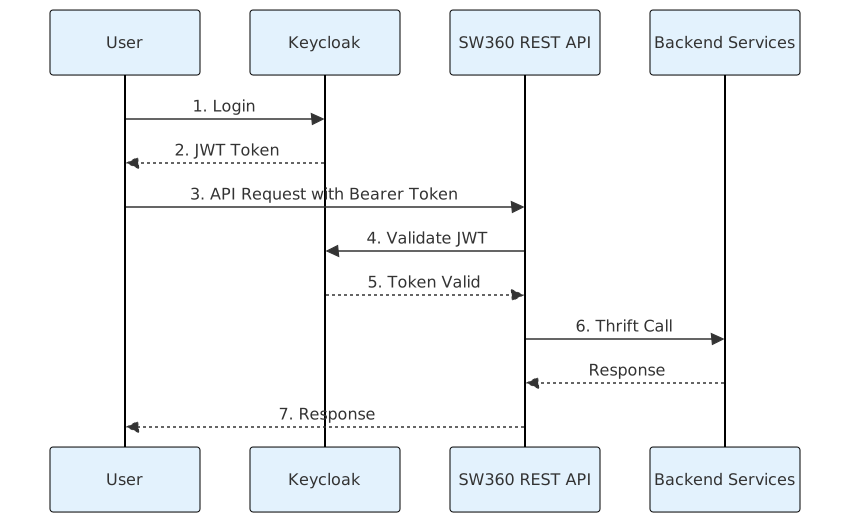
5.4.2 Authorization Model
| Level | Mechanism | Description |
|---|---|---|
| API Level | @PreAuthorize | Role-based endpoint access |
| Service Level | PermissionUtils | Business rule validation |
| Document Level | DocumentPermissions | Owner/moderator checks |
5.4.3 User Roles Hierarchy

5.5 Data Strategy
5.5.1 Database Design Approach
- Document-oriented: Each entity is a self-contained document
- Denormalization: Related data embedded where appropriate
- ID References: Cross-document relationships via ID fields
- Views: Pre-computed indexes for common queries
- Attachments: Binary files stored with parent documents
5.5.2 Consistency Model
| Scenario | Approach |
|---|---|
| Single document | Optimistic locking via revision |
| Cross-document | Eventually consistent |
| Aggregations | Computed on read or via views |
| Conflicts | Automatic conflict detection, manual resolution |
6. Building Block View
This section describes the static decomposition of SW360 into modules.
6.1 Level 1: System Overview
| Module | Path | Description |
|---|---|---|
| rest | rest/ | REST API layer with Spring Boot |
| backend | backend/ | Thrift-based business services |
| libraries | libraries/ | Shared libraries and utilities |
| keycloak | keycloak/ | Keycloak integration providers |
| clients | clients/ | Java client SDK |
6.2 REST Layer
Controllers and Services
| Package | Purpose | Key Classes |
|---|---|---|
*.project | Project management | ProjectController, Sw360ProjectService |
*.component | Component management | ComponentController, Sw360ComponentService |
*.release | Release management | ReleaseController, Sw360ReleaseService |
*.license | License database | LicenseController, Sw360LicenseService |
*.vulnerability | CVE tracking | VulnerabilityController, Sw360VulnerabilityService |
*.packages | Package (pURL) management | PackageController, SW360PackageService |
*.user | User management | UserController, Sw360UserService |
*.vendor | Vendor management | VendorController, Sw360VendorService |
*.obligation | Obligation management | ObligationController, Sw360ObligationService |
*.core | Shared utilities | RestControllerHelper, JacksonCustomizations |
Core Components
- RestControllerHelper: Common utilities for controllers (pagination, user extraction)
- JacksonCustomizations: JSON serialization mixins for Thrift objects
- RestExceptionHandler: Global exception handling with @ControllerAdvice
- ThriftClients: Factory for creating Thrift service clients
6.3 Backend Services
| Module | Thrift Service | Responsibilities |
|---|---|---|
| components | ComponentService | Component/Release CRUD, search, clearing states |
| projects | ProjectService | Project management, linked releases, clearing requests |
| licenses | LicenseService | License database, obligations, license types |
| vulnerabilities | VulnerabilityService | CVE data, release-vulnerability relations |
| attachments | AttachmentService | File uploads, attachment validation |
| moderation | ModerationService | Moderation requests, approval workflows |
| users | UserService | User management, authentication data |
| vendors | VendorService | Vendor database management |
| packages | PackageService | Package URLs (pURL) management |
| fossology | FOSSologyService | FOSSology integration |
| cvesearch | CVESearchService | CVE-Search synchronization |
| schedule | ScheduleService | Scheduled tasks (CVE updates, etc.) |
| licenseinfo | LicenseInfoService | License info parsing and generation |
| changelogs | ChangeLogsService | Audit trail and change tracking |
Handler Pattern
Each backend module follows this pattern:
- Handler (e.g.,
ComponentHandler): Implements Thrift service interface - DatabaseHandler (e.g.,
ComponentDatabaseHandler): Business logic - Repository (e.g.,
ComponentRepository): CouchDB access - SearchHandler (optional): Full-text search implementation
6.4 Libraries
| Library | Purpose |
|---|---|
| datahandler | Thrift definitions, CouchDB client, common utilities |
| commonIO | Attachment handling, SPDX/CycloneDX parsing |
| exporters | License info export (README_OSS), Excel reports |
| importers | SPDX, CycloneDX, CSV import functionality |
datahandler Key Components
- Thrift Definitions (
src/main/thrift/): All entity definitions - CouchDB Client (
cloudantclient/): Database access layer - Common Utilities (
common/): SW360Utils, CommonUtils, SW360Assert - Permissions (
permissions/): Document-level permission checking
6.5 Keycloak Integration
| Component | Purpose |
|---|---|
| user-storage-provider | Reads users from SW360 CouchDB for Keycloak auth |
| event-listeners | Creates SW360 users when registered in Keycloak |
6.6 Data Model
Core Entities
| Entity | Description | Key Fields |
|---|---|---|
| Component | Software component | name, componentType, vendor |
| Release | Specific version | version, clearingState, mainLicenseIds |
| Project | Collection of releases | name, linkedReleases, clearingState |
| License | License definition | shortName, fullName, obligations |
| Obligation | License obligation | title, text, obligationLevel |
| Vulnerability | CVE/security issue | externalId, cvss, references |
| Package | Distribution with pURL | name, version, purl |
| User | Application user | email, department, userGroup |
| Vendor | Component vendor | fullname, shortname, url |
Entity Relationships
- Component 1:N Release (one component has many releases)
- Project N:M Release (projects link to releases)
- Release N:M License (releases have licenses)
- License N:M Obligation (licenses have obligations)
- Release N:M Vulnerability (releases affected by vulnerabilities)
- Component N:1 Vendor (components have one vendor)
6.7 Thrift Service Architecture

7. Runtime View
This section describes the behavior of the system at runtime through important use cases and scenarios.
7.1 Component Creation Flow
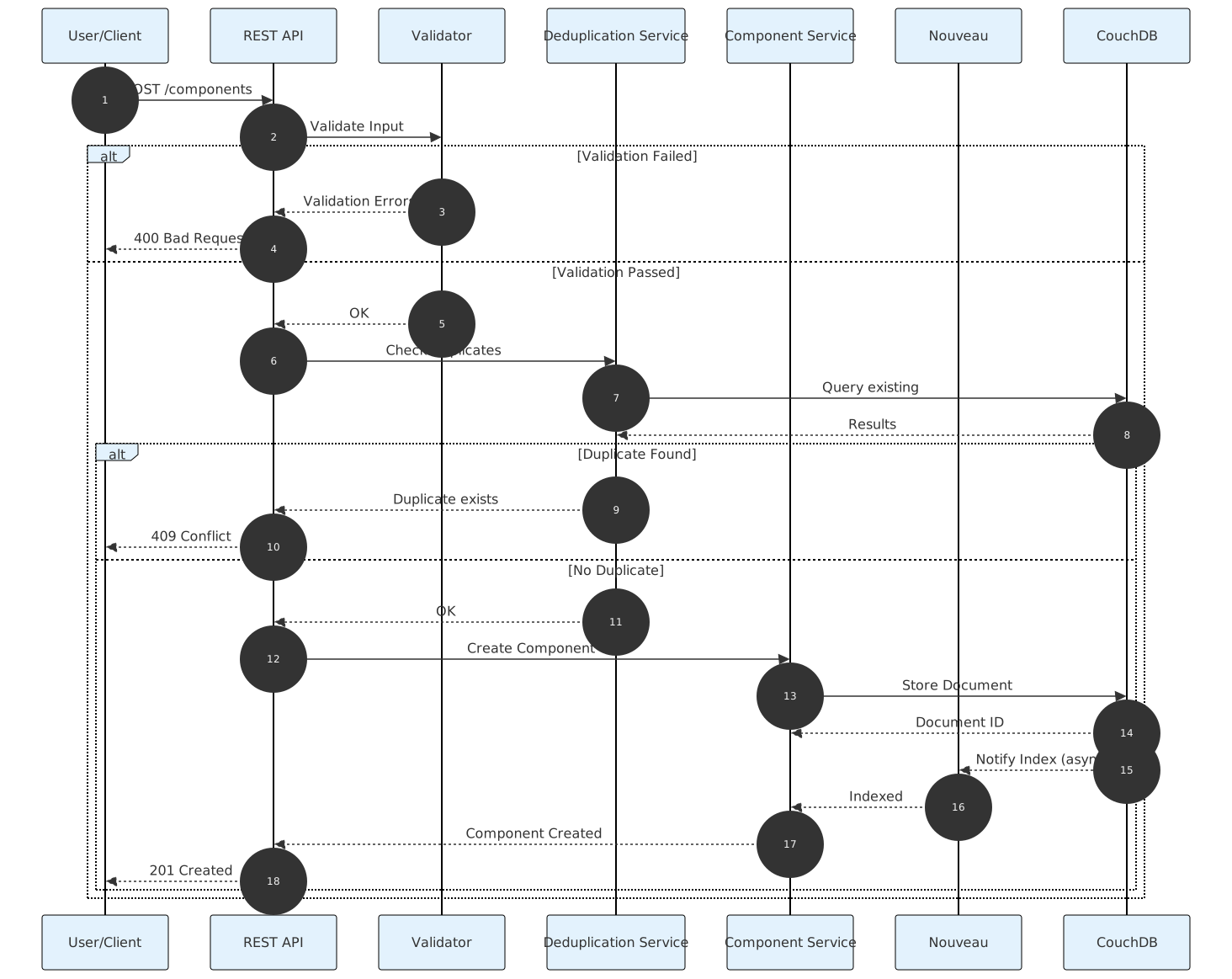
Note: Search indexing occurs asynchronously - CouchDB’s view update mechanism notifies Nouveau directly, not through the SW360 application.
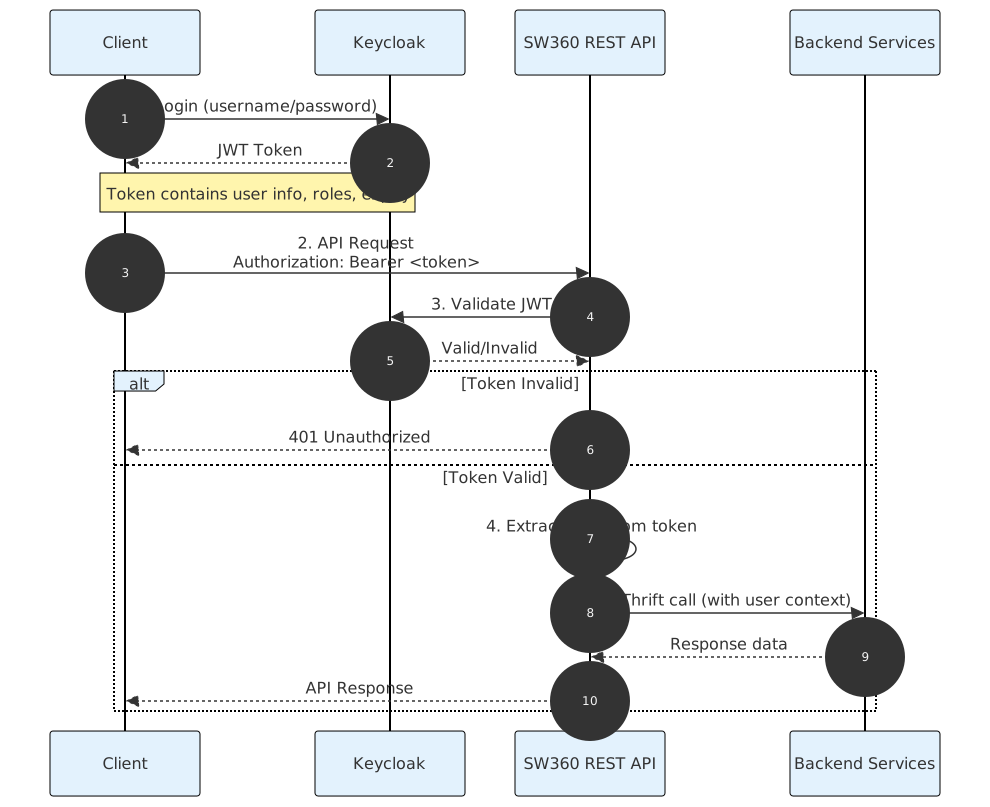
7.2 Authentication Flow (JWT)
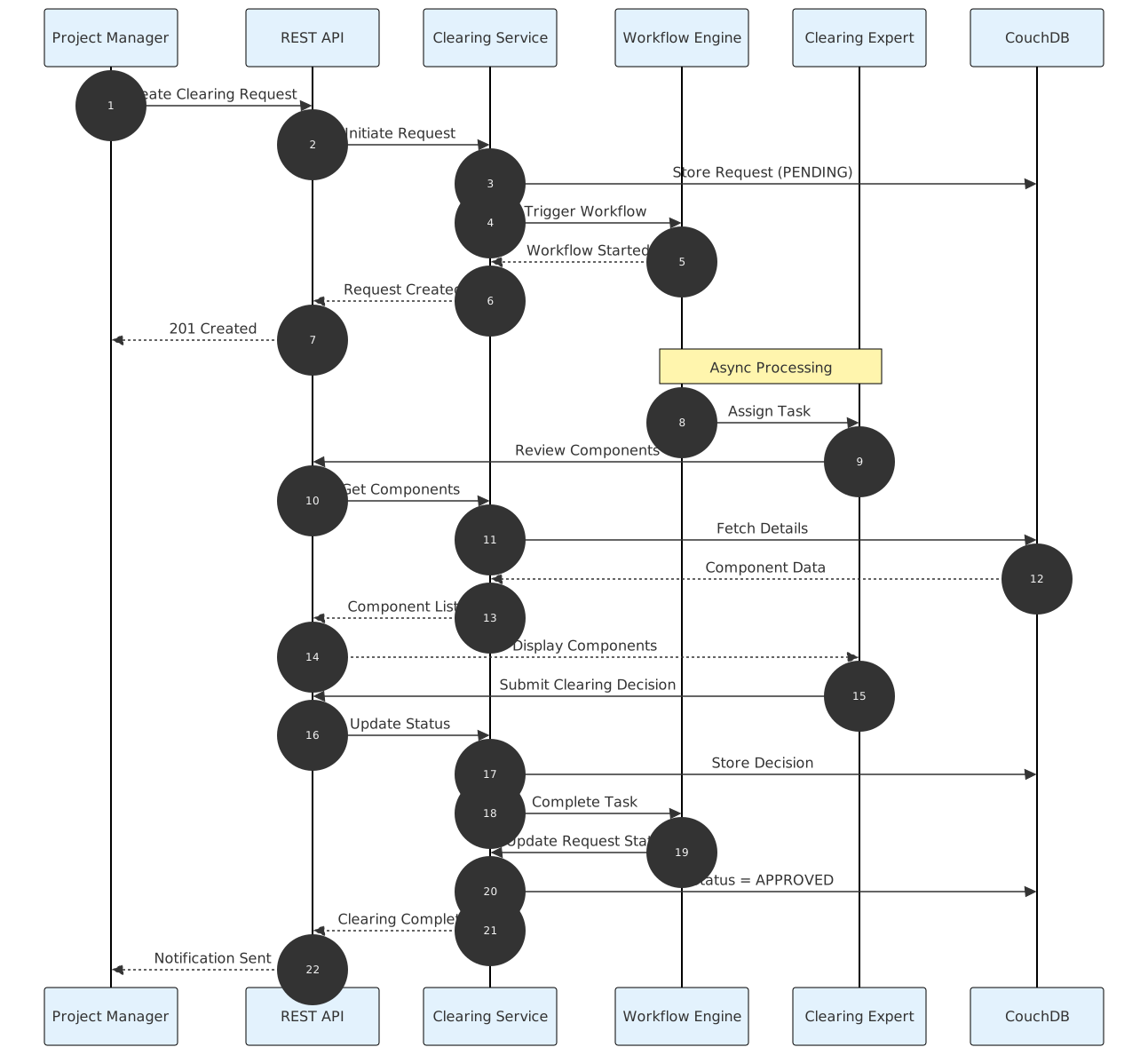
7.3 Clearing Request Workflow
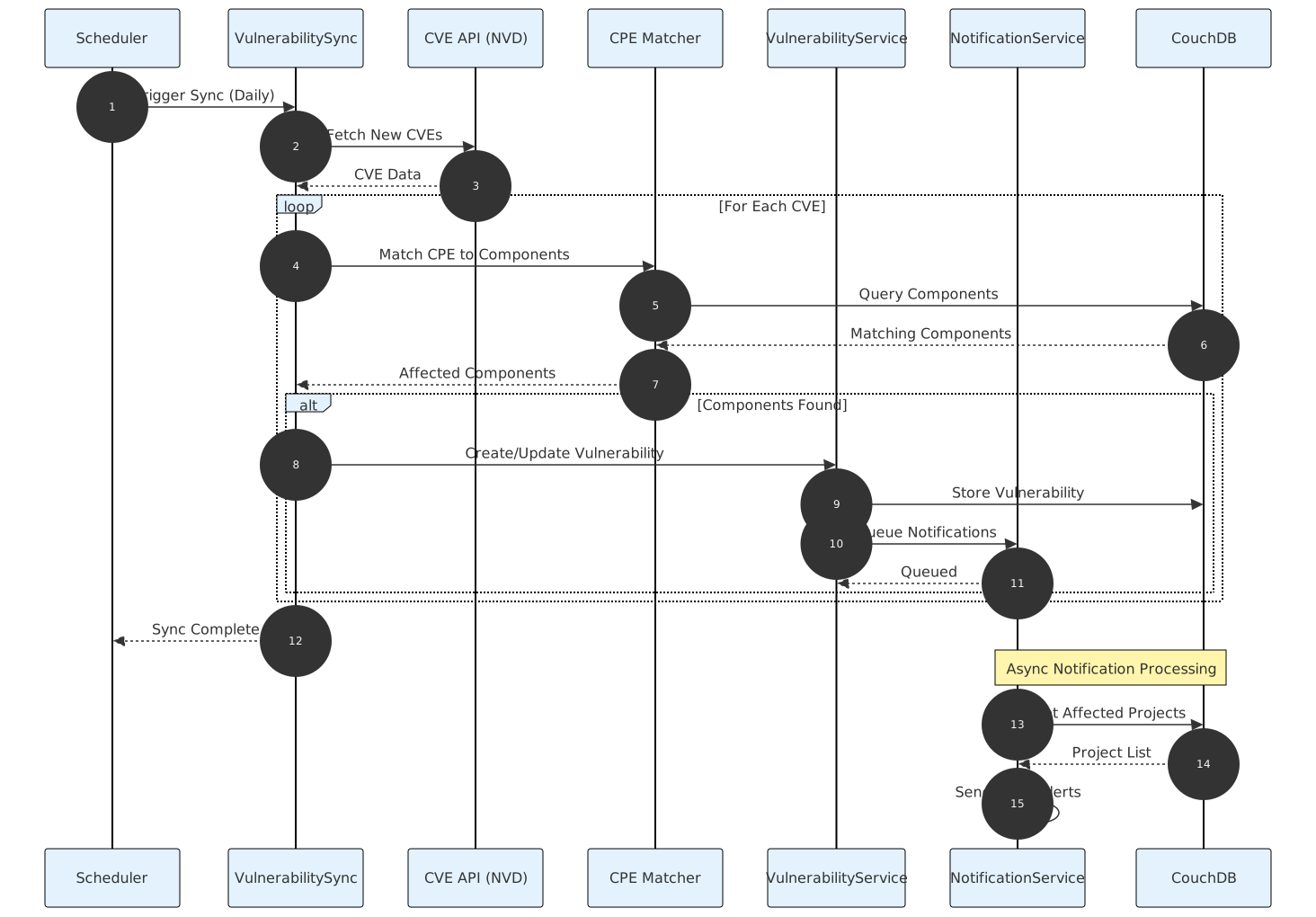
7.4 Vulnerability Synchronization
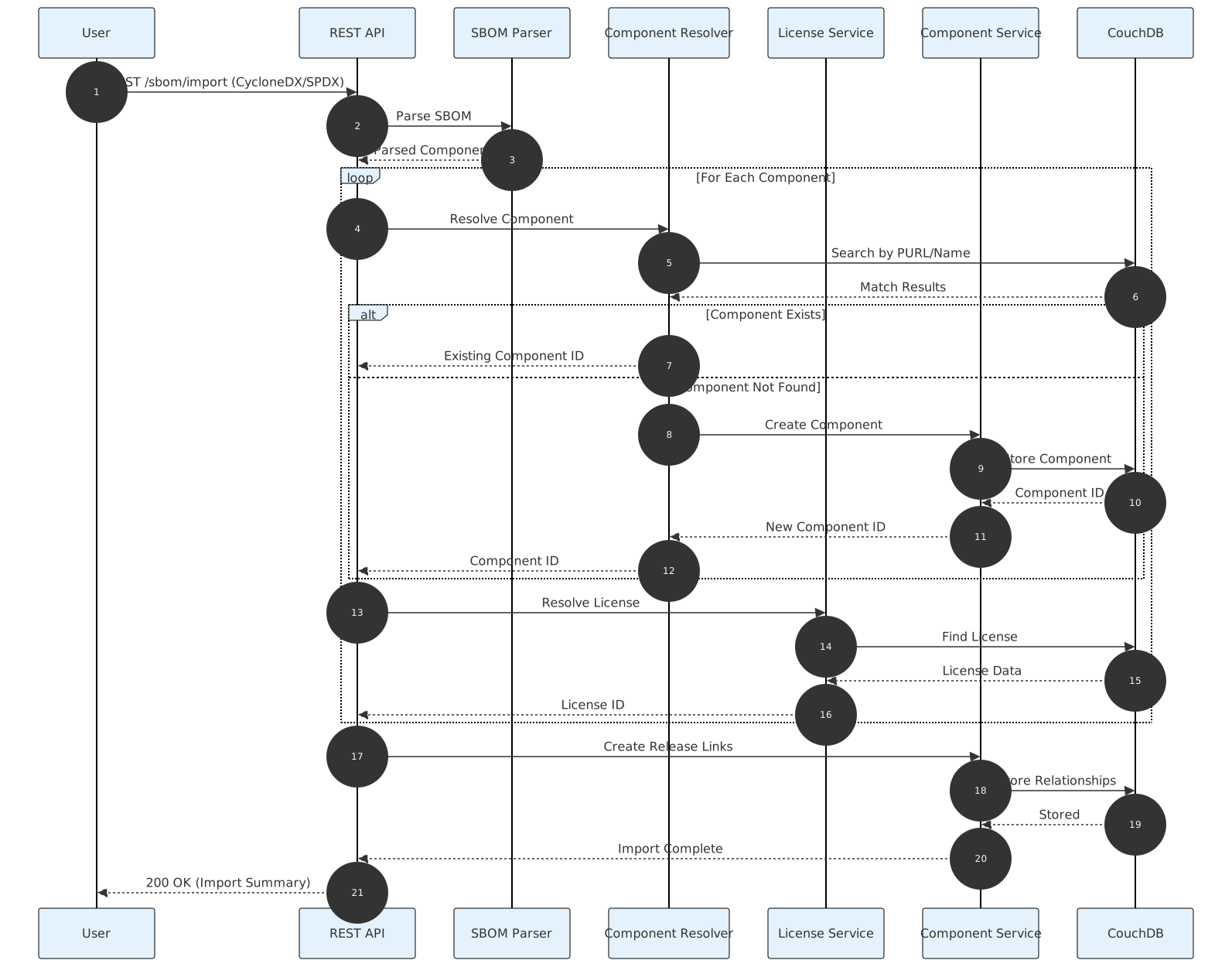
7.5 SBOM Import Flow
7.6 API Caching Flow
SW360 implements a file-based API response cache for resource-intensive endpoints like GET /releases?allDetails=true. This caching mechanism avoids JVM heap pressure by storing pre-serialized JSON responses on disk.
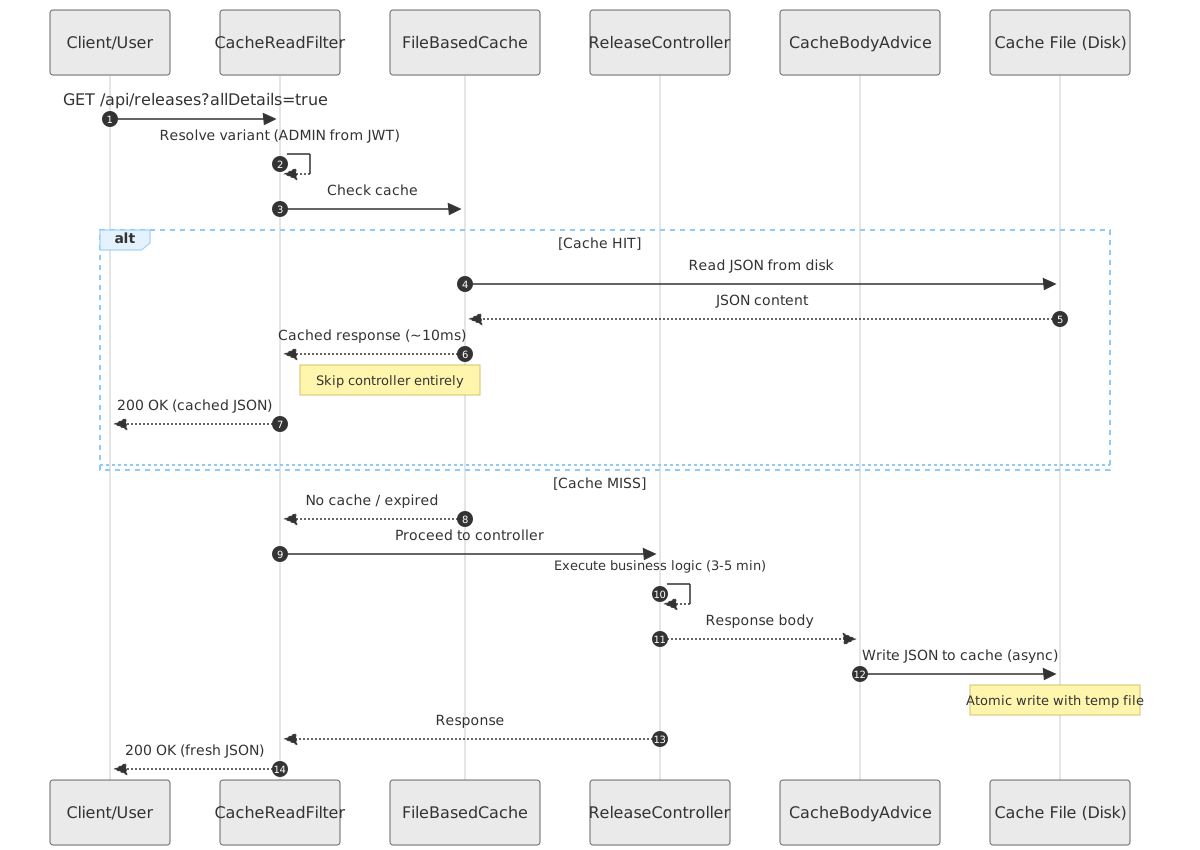
Key Design Decisions:
| Aspect | Approach |
|---|---|
| Storage | File-based (avoids heap memory pressure) |
| Per-Role Variants | Separate cache files per UserGroup (ADMIN, USER, etc.) |
| Invalidation | TTL-based + manual via Admin API + automatic on data mutations |
| Stale Handling | Stale-while-revalidate pattern for background refresh |
Reference: See ADR-007: File-Based API Response Cache for detailed rationale and implementation guidance.
8. Deployment View
This section describes the infrastructure and deployment architecture of SW360.
8.1 Deployment Overview

8.2 Container Specification
8.2.1 SW360 Application Container
| Attribute | Value |
|---|---|
| Image | ghcr.io/eclipse-sw360/sw360:latest |
| Base | Eclipse Temurin JDK 21 |
| Exposed Ports | 8080 (REST), 11311 (Thrift) |
| Health Check | /health endpoint |
Environment Variables:
| Variable | Description | Default |
|---|---|---|
SW360_BASE_URL | Base URL for SW360 | http://localhost:8080 |
COUCHDB_URL | CouchDB connection URL | http://couchdb:5984 |
COUCHDB_USER | CouchDB username | - |
COUCHDB_PASSWORD | CouchDB password | - |
8.2.2 CouchDB Container
| Attribute | Value |
|---|---|
| Image | couchdb:3.4 |
| Exposed Ports | 5984 (HTTP API) |
| Data Volume | couchdb:/opt/couchdb/data |
Databases:
| Database | Purpose |
|---|---|
sw360db | Main application data |
sw360users | User data |
sw360attachments | Attachment metadata |
8.2.3 Keycloak Container
| Attribute | Value |
|---|---|
| Image | quay.io/keycloak/keycloak:26.x |
| Exposed Ports | 8083 (HTTP), 8533 (HTTPS) |
| Database | PostgreSQL |
8.3 Docker Compose Configuration
The canonical compose definition and operational container setup are maintained in the frontend repository:
SW360 Frontend Docker Guide (eclipse-sw360/sw360-frontend)
This architecture document intentionally does not duplicate compose snippets to avoid drift between repositories.
8.4 Production Deployment Considerations
8.4.1 High Availability Architecture

Load Balancing: CouchDB cluster deployments require a load balancer (e.g., HAProxy, nginx) in front of cluster nodes to distribute client requests and provide failover.
8.4.2 Scaling Guidelines
| Component | Scaling Strategy |
|---|---|
| SW360 REST/Backend | Horizontal (stateless) |
| CouchDB | Cluster mode (3+ odd nodes for quorum) |
| Keycloak | Cluster mode with shared DB |
| Attachments | External storage (S3/NFS) recommended; currently stored in CouchDB |
8.4.3 Minimum Requirements
| Component | CPU | Memory | Storage |
|---|---|---|---|
| SW360 (per instance) | 2 cores | 4 GB | 1 GB |
| CouchDB (per node) | 2 cores | 4 GB | 50+ GB |
| Keycloak | 1 core | 1 GB | 1 GB |
| PostgreSQL (Keycloak) | 1 core | 1 GB | 10 GB |
8.5 Configuration Files
For detailed configuration file reference, see the existing deployment documentation:
👉 Deploy Configuration Files
8.6 Deployment Checklist
Pre-deployment
- CouchDB databases created and initialized
- Keycloak realm and client configured
- SSL certificates provisioned
- Secrets managed (Vault, K8s secrets, etc.)
- Network firewall rules configured
Post-deployment
- Health endpoint responding (
/health) - Authentication working (Keycloak login)
- Database connectivity verified
- API endpoints accessible
- Scheduled tasks running (CVE sync)
- Logging configured and working
8.7 Infrastructure as Code (IaC)
For reproducible and version-controlled deployments, SW360 infrastructure can be defined using IaC tools:
| Tool | Use Case | Examples |
|---|---|---|
| Terraform | Cloud infrastructure provisioning | VMs, networks, storage |
| Ansible | Configuration management | SW360 installation, CouchDB setup |
| Helm | Kubernetes deployments | SW360 Helm charts |
| Docker Compose | Local/dev environments | Development setup |
IaC Principles:
- Store infrastructure definitions in version control
- Use parameterized templates for environment-specific values
- Implement CI/CD for infrastructure changes
- Maintain separate configurations for dev/staging/production
9. Cross-cutting Concepts
This section describes cross-cutting technical concepts that apply across the entire SW360 system.
9.1 Security Concepts
9.1.1 Authentication
SW360 supports multiple authentication mechanisms:
| Method | Use Case | Configuration |
|---|---|---|
| Keycloak JWT | Primary (OAuth2/OIDC) | spring.security.oauth2.resourceserver.jwt.* |
| API Token | Programmatic access | rest.apitoken.* in sw360.properties |
| Basic Auth | Development/testing | Spring Security basic |
9.1.2 Authorization Model

9.1.3 User Roles
| Role | Level | Capabilities |
|---|---|---|
USER | Base | View, create components/projects |
CLEARING_EXPERT | Elevated | Clearing workflow actions |
CLEARING_ADMIN | Admin | Approve clearings, manage obligations |
ECC_ADMIN | Admin | Export control management |
SECURITY_ADMIN | Admin | Vulnerability management |
SW360_ADMIN | Super | Full application admin |
ADMIN | System | System-level administration |
9.1.4 Document Visibility
enum Visibility {
    PRIVATE,                    // Only creator
    ME_AND_MODERATORS,          // Creator + moderators
    BUISNESSUNIT_AND_MODERATORS,// Same business unit
    EVERYONE                    // All authenticated users
}
9.2 Persistence Concepts
9.2.1 CouchDB Design Principles
| Principle | Implementation |
|---|---|
| Document-oriented | Each entity is a self-contained JSON document |
| ID-based references | Related documents linked by ID fields |
| Optimistic locking | _rev field for conflict detection |
| Views for queries | MapReduce views for common query patterns |
| Attachments | Binary files stored with documents |
9.2.2 Repository Pattern
// Base repository class
public class ComponentRepository extends DatabaseRepositoryCloudantClient<Component> {

    public ComponentRepository(DatabaseConnectorCloudant db) {
        super(db, Component.class);
        initStandardDesignDocument(getViews(), db);
    }

    // Query using CouchDB views
    public List<Component> getByName(String name) {
        return queryView("byName", name);
    }

    // Query using Mango selectors
    public List<Component> getByType(ComponentType type) {
        Map<String, Object> selector = eq("componentType", type.name());
        return db.queryBySelector(selector, Component.class);
    }
}
9.2.3 Query Operators
import static org.eclipse.sw360.datahandler.cloudantclient.DatabaseConnectorCloudant.*;

// Equality
eq("field", "value")

// In list
in("field", List.of("a", "b", "c"))

// Exists
exists("field", true)

// Logical operators
and(condition1, condition2)
or(condition1, condition2)

// Element match (arrays)
elemMatch("releases", eq("clearingState", "APPROVED"))
9.3 API Design Concepts
9.3.1 REST Conventions
| Aspect | Convention |
|---|---|
| Base path | /api |
| Resource naming | Plural nouns (/projects, /components) |
| HTTP methods | GET (read), POST (create), PATCH (update), DELETE |
| Response format | HAL+JSON |
| Pagination | page, page_entries parameters |
| Error format | Problem Details (RFC 7807) |
9.3.2 HATEOAS Links
HATEOAS (Hypermedia as the Engine of Application State) is a REST constraint that enables clients to navigate the API dynamically through hyperlinks embedded in responses. Rather than hardcoding API endpoints, clients discover available actions from the _links object returned with each resource. This decouples client logic from server URL structure, enabling API evolution without breaking clients.
{
  "name": "My Project",
  "_links": {
    "self": { "href": "/api/projects/abc123" },
    "sw360:releases": { "href": "/api/projects/abc123/releases" },
    "sw360:attachments": { "href": "/api/projects/abc123/attachments" },
    "curies": [{ "name": "sw360", "href": "/docs/{rel}.html" }]
  },
  "_embedded": {
    "sw360:releases": [...]
  }
}
9.4 Error Handling
9.4.1 Exception Hierarchy
Exception
├── SW360Exception (Thrift layer)
│   └── errorCode: 400, 403, 404, 409, 500
├── ResourceNotFoundException (REST)
├── AccessDeniedException (REST)
├── BadRequestClientException (REST)
└── DataIntegrityViolationException (REST)
9.4.2 Global Exception Handler
@ControllerAdvice
public class RestExceptionHandler {

    @ExceptionHandler(ResourceNotFoundException.class)
    public ResponseEntity<ErrorResponse> handleNotFound(ResourceNotFoundException ex) {
        return ResponseEntity.status(404).body(
            new ErrorResponse(404, "Not Found", ex.getMessage())
        );
    }

    @ExceptionHandler(AccessDeniedException.class)
    public ResponseEntity<ErrorResponse> handleAccessDenied(AccessDeniedException ex) {
        return ResponseEntity.status(403).body(
            new ErrorResponse(403, "Forbidden", ex.getMessage())
        );
    }
}
9.5 Logging
9.5.1 Logging Standards
| Level | Usage |
|---|---|
DEBUG | Detailed debugging information |
INFO | Business events, state changes |
WARN | Potential issues, deprecations |
ERROR | Failures requiring attention |
9.5.2 Structured Logging
// Good: Parameterized logging
log.info("Processing {} releases for project {}", count, projectId);

// Bad: String concatenation
log.info("Processing " + count + " releases for project " + projectId);
9.6 Validation
9.6.1 Input Validation
import static org.eclipse.sw360.datahandler.common.SW360Assert.*;

public void createComponent(Component component, User user) throws SW360Exception {
    // Validate inputs
    assertNotNull(component, "Component cannot be null");
    assertNotEmpty(component.getName(), "Component name is required");
    assertUser(user);

    // Business validation
    if (componentExists(component.getName())) {
        throw new SW360Exception("Component already exists")
            .setErrorCode(409);
    }
}
10. Architecture Decisions
This section documents key architecture decisions using the ADR (Architecture Decision Record) format.
ADR-001: Use Apache Thrift for Internal Services
| Attribute | Value |
|---|---|
| Status | Accepted (2014) |
| Context | SW360 needed efficient, reliable communication between web layer and backend services. Apache Thrift was introduced primarily to enable integration with FOSSology, which at the time did not have a REST API (neither did SW360). Thrift’s cross-language support made it ideal for inter-system communication. |
| Decision | Use Apache Thrift as the internal RPC framework |
Rationale:
- Efficient Binary Protocol: Thrift’s binary protocol is more compact than JSON/XML
- Interface Definition Language (IDL): Formal contracts between services
- Code Generation: Generates strongly-typed Java classes
- Complex Data Structures: Native support for nested structs, maps, sets, lists
- Cross-Language Support: Supports Python, C++, PHP for future integration
Consequences:
- ✅ Strong typing, performance, clear contracts, backward compatibility
- ❌ Learning curve, build complexity, debugging difficulty
ADR-002: Use CouchDB as Primary Database
| Attribute | Value |
|---|---|
| Status | Accepted (2014) |
| Context | SW360 manages software components with complex, evolving data structures |
| Decision | Use Apache CouchDB as the primary database |
Rationale:
- Schema Flexibility: Documents can have different structures without migrations
- Attachment Storage: Binary attachments stored directly with documents
- RESTful HTTP API: Simple integration without special drivers
- Replication: Built-in master-master replication for disaster recovery
- MVCC: Optimistic locking via
_revfield prevents concurrent update conflicts
Consequences:
- ✅ Flexible data model, attachment handling, HTTP API, replication
- ❌ No SQL joins, eventual consistency, query limitations
ADR-003: Use Keycloak for Authentication
| Attribute | Value |
|---|---|
| Status | Accepted (2022) |
| Context | Migration away from Liferay required a new authentication solution |
| Decision | Use Keycloak as the identity provider |
Rationale:
- Open Source & Self-Hosted: No vendor lock-in, full control over user data
- Enterprise Features: LDAP/AD federation, SAML 2.0, OIDC, MFA
- Standard Protocols: OAuth 2.0 for API authentication, OIDC for identity
- Customization: Custom user storage providers, event listeners
- Active Community: Red Hat backing, regular security updates
Consequences:
- ✅ SSO support, JWT tokens, federation, security, API tokens
- ❌ Additional component to maintain, OAuth2 complexity
ADR-004: Migrate to Spring Boot 3.x
| Attribute | Value |
|---|---|
| Status | Accepted (2024) |
| Context | Spring Boot 2.x reached end of support |
| Decision | Migrate to Spring Boot 3.5.x with Java 21 |
Rationale:
- Long-term Support: Spring Boot 3.x is actively maintained
- Security Improvements: Spring Security 6 includes enhanced OAuth2 support
- Performance: Java 21 virtual threads, improved GC
- Modern APIs: Records, pattern matching, sealed classes
- Ecosystem: Latest versions of SpringDoc, Jackson, etc.
Key Changes:
- Namespace migration:
javax.*→jakarta.* - Security configuration: New DSL, authorization changes
- OpenAPI/SpringDoc: Version upgrade, annotation changes
ADR-005: Use Apache Tomcat as Servlet Container
| Attribute | Value |
|---|---|
| Status | Accepted (2014) |
| Context | SW360 was originally built on Liferay Portal, requiring servlet container support for multiple web applications |
| Decision | Use Apache Tomcat as the servlet container |
Rationale:
- Liferay Compatibility: Liferay portal required a servlet container
- Multiple Web Applications: Tomcat supports deployment of individual WAR files
- Industry Standard: Widely adopted, well-documented, production-proven
- Spring Boot Integration: Embedded Tomcat in Spring Boot 3.x (Tomcat 11.x)
Consequences:
- ✅ Standard servlet deployment, mature ecosystem, excellent documentation
- ❌ Additional configuration for performance tuning
ADR-006: Migrate to Cloudant SDK for CouchDB Access
| Attribute | Value |
|---|---|
| Status | Accepted (2024) |
| Context | The Ektorp library (previous CouchDB client) became deprecated and unmaintained |
| Decision | Migrate to IBM Cloudant SDK for CouchDB access |
Rationale:
- Ektorp Deprecation: Original CouchDB client library no longer maintained
- IBM Corporate Support: IBM unified their cloud support SDKs, backing active development
- CouchDB Compatibility: Cloudant SDK works with standard CouchDB (not just IBM Cloudant)
- Modern Java Support: Full Java 21 compatibility and async operations
Consequences:
- ✅ Active maintenance, corporate backing, modern API
- ❌ API migration effort, IBM branding (though works with any CouchDB)
11. Quality Requirements
This section describes the quality requirements for SW360 and how the architecture addresses them.
11.1 Quality Tree

11.2 Quality Scenarios
11.2.1 Performance
| ID | Scenario | Target |
|---|---|---|
| P1 | Get single component by ID | < 200ms |
| P2 | List 100 components | < 500ms |
| P3 | Search across 10,000 components | < 2s |
| P4 | Upload 50MB attachment | < 30s |
| P5 | Generate clearing report for project with 500 releases | < 60s |
11.2.2 Security
| ID | Scenario | Expected Response |
|---|---|---|
| S1 | Invalid JWT token presented | 401 Unauthorized returned |
| S2 | User without WRITE permission tries to modify | 403 Forbidden, moderation request created |
| S3 | API token expires | User must regenerate token |
| S4 | Cross-site scripting attempt | Input sanitized, XSS filter applied |
| S5 | Brute force login attempt | Keycloak rate limiting kicks in |
11.2.3 Scalability
| ID | Scenario | Expected Behavior |
|---|---|---|
| SC1 | 100 concurrent API requests | System handles without degradation |
| SC2 | Database grows to 1M documents | Query performance acceptable with proper indexes |
| SC3 | 1000 users in system | Authentication/authorization performs normally |
11.3 Quality Measures
11.3.1 Code Quality
| Metric | Target | Tool |
|---|---|---|
| Test coverage | > 60% | JaCoCo |
| Code formatting | 100% compliant | Spotless |
| Static analysis | No critical issues | SonarQube |
| Dependency vulnerabilities | No critical CVEs | OWASP Dependency Check, GitHub Dependabot |
11.3.2 Operational Quality
| Metric | Target | Monitoring |
|---|---|---|
| Availability | 99% uptime | Health endpoint |
| Error rate | < 1% of requests | Log analysis |
| Response time P95 | < 1s | Metrics |
11.4 Quality Trade-offs
| Trade-off | Decision | Rationale |
|---|---|---|
| Strong typing vs. flexibility | Strong typing (Thrift) | Prevents runtime errors |
| Performance vs. simplicity | Simplicity first | Optimize when needed |
| Features vs. maintenance | Core features only | Community-driven scope |
| Consistency vs. availability | Eventual consistency | CouchDB design fits use case |
12. Risks and Technical Debt
This section documents known risks and technical debt in the SW360 architecture.
12.1 Technical Risks
12.1.1 High Priority Risks
| ID | Risk | Impact | Probability | Mitigation |
|---|---|---|---|---|
| R1 | CouchDB scaling limits | Performance degradation with millions of documents | Medium | Monitor growth, consider sharding strategy |
| R2 | Thrift protocol changes | Breaking changes in Thrift 0.21+; pinned versions miss security patches | Medium | Pin version, test upgrades thoroughly, monitor security advisories |
| R3 | Keycloak provider compatibility | Custom providers break on Keycloak upgrades | Medium | Test providers with each Keycloak version |
| R4 | Single point of failure | CouchDB instance unavailable | Medium | Implement replication, monitoring |
12.1.2 Medium Priority Risks
| ID | Risk | Impact | Probability | Mitigation |
|---|---|---|---|---|
| R5 | JWT token security | Token theft enables unauthorized access | Low | Short expiry, token rotation |
| R6 | Attachment storage limits | Large attachments consume disk space | Medium | Implement quotas, archival strategy |
| R7 | Search performance | Nouveau search degrades with scale | Medium | Monitor, tune indexes |
| R8 | Dependency vulnerabilities | CVEs in third-party libraries | Medium | Regular dependency updates, scanning |
12.2 Technical Debt
12.2.1 High Priority Debt
| ID | Description | Impact | Proposed Solution |
|---|---|---|---|
| D1 | Inconsistent error handling | Different error formats across endpoints | Standardize on Problem Details (RFC 7807) |
| D2 | Missing pagination on some endpoints | Memory issues with large result sets | Add pagination to all list endpoints |
| D3 | Hardcoded configuration values | Difficult to customize deployments | Move to Spring Configuration properties |
12.2.2 Medium Priority Debt
| ID | Description | Impact | Proposed Solution |
|---|---|---|---|
| D4 | Limited test coverage | Regression risks | Increase coverage to 70%+ |
| D5 | Duplicated validation logic | Maintenance burden | Extract to shared validators |
| D6 | Inconsistent API naming | Confusing for API consumers | Establish naming conventions |
| D7 | Legacy Liferay references | Confusing, unused code | Remove obsolete code |
| D8 | Monolithic backend deployment | All services in one WAR | Consider microservices (long-term) |
12.3 Risk Monitoring
12.3.1 Key Metrics to Watch
| Metric | Warning Threshold | Critical Threshold |
|---|---|---|
| Database size | 50 GB | 100 GB |
| Document count | 500,000 | 1,000,000 |
| Response time P95 | 2s | 5s |
| Error rate | 1% | 5% |
| Memory usage | 80% | 95% |
12.4 Debt Reduction Plan
Short-term (Next Release)
- Standardize error responses
- Add missing pagination
- Update documentation
Medium-term (6 months)
- Increase test coverage to 70%
- Remove legacy Liferay code
- Implement comprehensive logging
Long-term (12+ months)
- Evaluate microservices architecture
- Consider caching layer
- Implement webhooks/async processing
13. Testing Strategy
This section describes the testing approach for SW360, following the Testing Trophy methodology.
13.1 Current State vs Target State
| Aspect | Current State | Target State |
|---|---|---|
| Shape | Pyramid | Trophy |
| Static Analysis | Spotless only | Spotless + SpotBugs + ArchUnit |
| Unit Tests | 60% | 25% |
| Integration Tests | 35% | 55% |
| E2E Tests | 5% (manual) | 5% (automated) |
| CouchDB Testing | Mocked | Testcontainers |
13.2 Test Pyramid vs Testing Trophy
Test Pyramid (Traditional)
                    /\
                   /  \      E2E Tests (Few, Slow, Expensive)
                  /----\
                 /      \    Integration Tests (Some)
                /--------\
               /          \  Unit Tests (Many, Fast, Cheap)
              --------------
Testing Pyramid (SW360 Approach)

13.3 Test Level Breakdown
| Level | Scope | SW360 Example |
|---|---|---|
| Unit | Single class/method | ComponentRepositoryTest |
| Integration | Multiple components | REST → Service → Handler → CouchDB |
| System | Complete deployed app | Full SW360 + Keycloak + CouchDB |
| Acceptance | Business requirements | “Can I generate clearing report?” |
13.4 Key Testing Principles
- Test behavior at the REST layer — that’s what users consume
- Static analysis is free testing — maximize it (Spotless, SpotBugs, ArchUnit)
- Unit test complex logic only — not glue code
- E2E tests are expensive — use sparingly for critical paths
- If you mock too much, test at a higher level
- Refactoring should not break tests — if it does, tests are too coupled
13.5 Recommended Tools
| Purpose | Tool |
|---|---|
| Unit Testing | JUnit 5, Mockito |
| Integration Testing | Testcontainers (CouchDB, Keycloak) |
| Static Analysis | Spotless, SpotBugs, ArchUnit |
| E2E Testing | Playwright |
| Code Coverage | JaCoCo |
13.6 Critical User Journeys for E2E
- Authentication Flow: Login → Access protected resource → Logout
- Component Lifecycle: Create Component → Add Release → Upload Source → Trigger Clearing
- Project Clearing: Create Project → Link Releases → Generate Clearing Report
- License Compliance: Search License → Check Obligations → Export Report
14. Glossary
This section defines terms used throughout the SW360 architecture documentation.
14.1 Domain Terms
| Term | Definition |
|---|---|
| Clearing | The process of reviewing and approving open source components for use |
| Clearing Request (CR) | A formal request to review and clear the components used in a project |
| Clearing State | The status of license review: NEW_CLEARING, UNDER_CLEARING, REPORT_AVAILABLE, APPROVED |
| Component | A software package or library without version information |
| COTS | Commercial Off-The-Shelf software; proprietary software purchased from vendors |
| CVE | Common Vulnerabilities and Exposures; unique identifiers for security vulnerabilities |
| CVSS | Common Vulnerability Scoring System; numerical score indicating vulnerability severity |
| ECC | Export Control Classification; regulations governing export of technology |
| License Obligation | Requirements imposed by a license (e.g., attribution, source disclosure) |
| Moderation Request | A request for moderators to review changes when user lacks permissions |
| OSS | Open Source Software; software with source code freely available |
| OSPO | Open Source Program Office; team managing open source strategy |
| Package | A specific distribution of a release, identified by a pURL |
| Project | A software product that uses components/releases |
| pURL | Package URL; a standardized way to identify software packages |
| Release | A specific version of a component |
| SBOM | Software Bill of Materials; list of components in a software product |
| Vendor | The organization that creates/maintains a component |
| Vulnerability | A security weakness in software that could be exploited |
14.2 Technical Terms
| Term | Definition |
|---|---|
| CouchDB | Apache CouchDB; document-oriented database used by SW360 |
| HAL | Hypertext Application Language; JSON format for hypermedia APIs |
| HATEOAS | Hypermedia as the Engine of Application State; REST constraint |
| JWT | JSON Web Token; compact token format for secure claims transmission |
| Keycloak | Open source identity and access management solution |
| Nouveau | CouchDB’s built-in full-text search engine |
| OAuth2 | Authorization framework for secure API access |
| OIDC | OpenID Connect; identity layer on top of OAuth2 |
| REST | Representational State Transfer; architectural style for web services |
| Thrift | Apache Thrift; framework for scalable cross-language services |
14.3 Standards and Specifications
| Term | Definition |
|---|---|
| CycloneDX | SBOM standard focused on security and supply chain |
| EPL-2.0 | Eclipse Public License 2.0; SW360’s license |
| RFC 7807 | Problem Details for HTTP APIs; standard error format |
| SPDX | Software Package Data Exchange; standard for SBOM and license info |
14.4 Abbreviations
| Abbreviation | Full Form |
|---|---|
| ADR | Architecture Decision Record |
| API | Application Programming Interface |
| CI/CD | Continuous Integration/Continuous Deployment |
| CRUD | Create, Read, Update, Delete |
| DTO | Data Transfer Object |
| IDL | Interface Definition Language |
| JWT | JSON Web Token |
| LTS | Long-Term Support |
| MVCC | Multi-Version Concurrency Control |
| RBAC | Role-Based Access Control |
| RPC | Remote Procedure Call |
| SSO | Single Sign-On |
15. Frontend Architecture (React UI)
For the full frontend architecture documentation, see the dedicated document:
👉 SW360 Frontend Architecture
Appendix A: Revision History
| Version | Date | Author | Changes |
|---|---|---|---|
| 1.0 | March 2026 | SW360 Architecture Team | Initial document |
| 1.1 | May 2026 | SW360 Architecture Team | Added frontend placeholder, ADR-008 (Spring Boot 4.x) |
Appendix B: References
- Arc42 Template: https://arc42.org/
- Eclipse SW360: https://eclipse.dev/sw360/
- Apache CouchDB: https://couchdb.apache.org/
- Apache Thrift: https://thrift.apache.org/
- Keycloak: https://www.keycloak.org/
- Spring Boot: https://spring.io/projects/spring-boot
- SPDX Specification: https://spdx.dev/
- CycloneDX Specification: https://cyclonedx.org/
This program and the accompanying materials are made available under the terms of the Eclipse Public License 2.0 which is available at https://www.eclipse.org/legal/epl-2.0/