
Eclipse 4diac at OCX 2026: 18 Years of Eclipse RCP
Eclipse 4diac committer Michael Oberlehner presented how Eclipse 4diac grew from a research prototype into an industry-grade open-source toolchain for IEC 61499-based automation. The recording is now available, and an upcoming webinar will continue the topic with a focus on maintaining large IEC 61499 applications.
The recording of the talk is now available on YouTube: Watch “18 Years of Eclipse 4diac – An Eclipse RCP Success Story”.
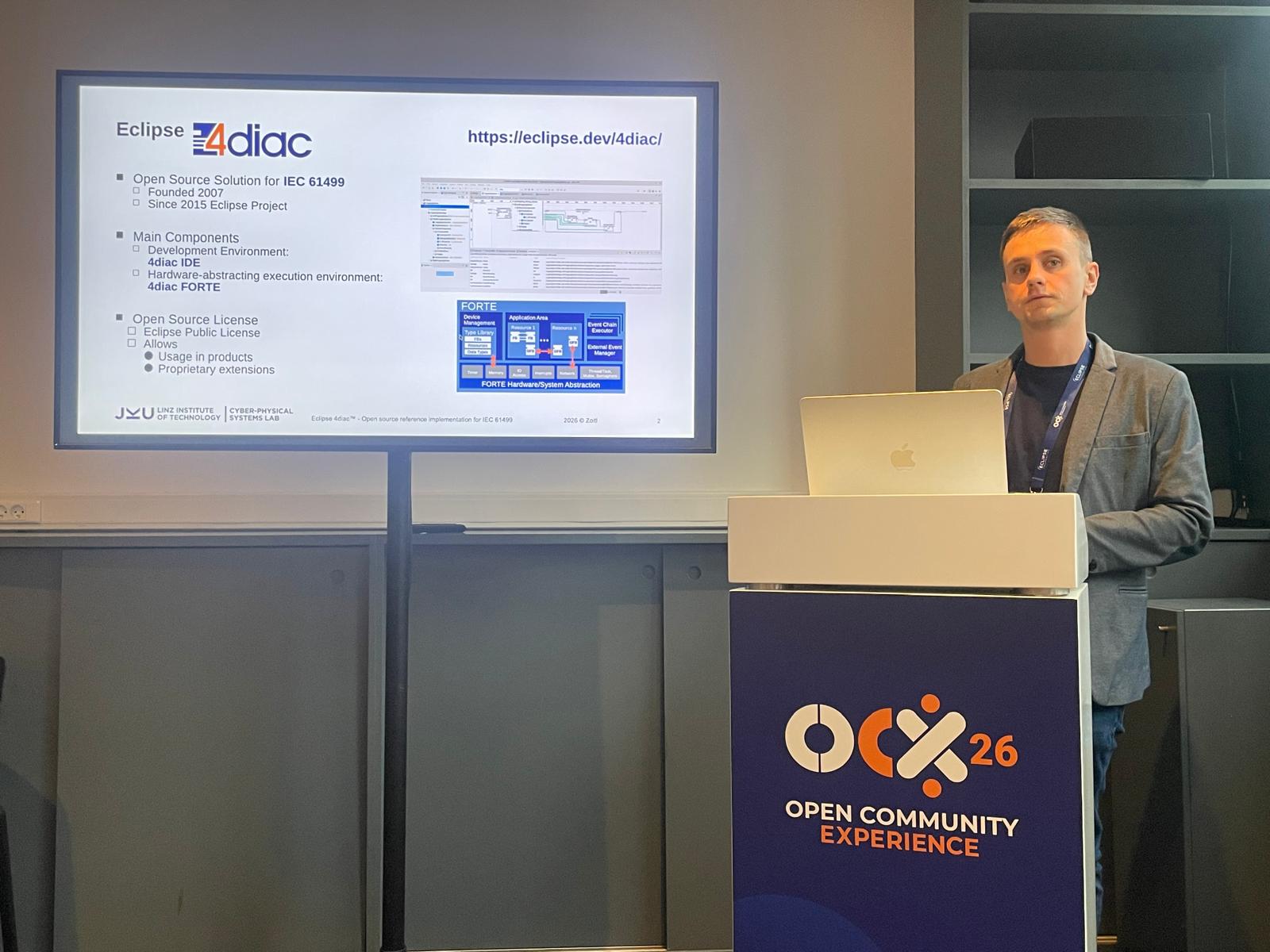
Michael Oberlehner, Eclipse 4diac committer, presented the journey of the project from its first beginnings in 2007 to today’s mature open-source toolchain for distributed industrial automation based on IEC 61499.
The talk highlighted how Eclipse 4diac started as a research-driven project and grew into an industry-grade development environment. A key part of this journey has been Eclipse RCP, which provided the foundation for building a modular, extensible, and long-living engineering tool with limited development resources in the early years.
Over the last 18 years, Eclipse 4diac has evolved into an ecosystem consisting of:
- 4diac IDE for designing and configuring IEC 61499 applications
- 4diac FORTE as a portable runtime environment
- 4diac FBE as a modern build environment
The presentation also reflected on lessons learned from building and maintaining a long-running Eclipse RCP application: embrace EMF, reuse Eclipse Platform components instead of reinventing them, update dependencies regularly, avoid internal APIs where possible, and contribute improvements upstream whenever they are useful beyond the project itself.
Technologies such as EMF, GEF Classic, Xtext, Eclipse Platform, the Common Navigator Framework, ELK, Nebula, NatTable, and Trace Compass helped shape 4diac IDE and allowed the project to focus on IEC 61499 engineering workflows while standing on a strong and proven platform.
The session was also a reminder that Eclipse 4diac is not only a tool, but a community effort. Contributions from academia, industry, research projects, and individual developers have helped bring the project to where it is today.
Looking ahead, Eclipse 4diac will continue to modernize its tooling, improve usability and performance, strengthen interoperability with open industrial automation technologies, and support the growing adoption of IEC 61499 in research, teaching, and industrial applications.
For everyone interested in these topics, Michael will also host a webinar on 26 May 2026 at 14:00 Vienna time: Maintaining Large IEC 61499 Applications with Eclipse 4diac.
Large IEC 61499 applications are long-living engineering assets. They grow over time, rely on reusable function blocks and data types, and must be maintained without breaking existing systems. The webinar gives a short overview of Eclipse 4diac and then focuses on how 4diac IDE supports the maintenance of larger control applications.
The session introduces recent improvements in Eclipse 4diac 3.1 and shows how library management can help structure reusable types through clearer project organization, explicit dependencies, versioned libraries, update workflows, and integration with remote repositories. It will also look at practical maintenance features such as refactoring support and improved error handling in the graphical IDE. The goal is to show how Eclipse 4diac can support engineers in evolving IEC 61499 systems more safely, making large automation projects easier to share, update, restructure, and maintain over time.
Many thanks to everyone who joined the session at OCX and to the Eclipse community for supporting long-term open-source innovation.
Cheers,
The Eclipse 4diac Team