
Understanding Aidge’s architecture#
Modular by design, flexible by nature#
Aidge is built on a robust and flexible modular architecture, a foundational pillar that sets it apart. This modularity isn’t just a technical feature; it’s crucial for Aidge’s customization, extensibility, and adaptability to the diverse and evolving demands of AI deployment.
Core principles driving our design:
Plugin-driven: we engineered a lightweight core module designed for seamless expansion with easily integrated plug-ins.
Dependency minimization: this approach simplifies integration and management, avoiding conflicts within your current workflows.
By breaking down the framework into distinct, interchangeable components, Aidge offers key advantages:
Pick and choose: integrate only the functionalities you need.
Customize freely: replace existing functionalities with your own implementations.
Expand easily: add new capabilities without touching the core system.
Code engagement: quickly understand, explore, and contribute to relevant parts of the codebase.
Discover how easy it is to add an operator to the C++ export by doing our tutorial.
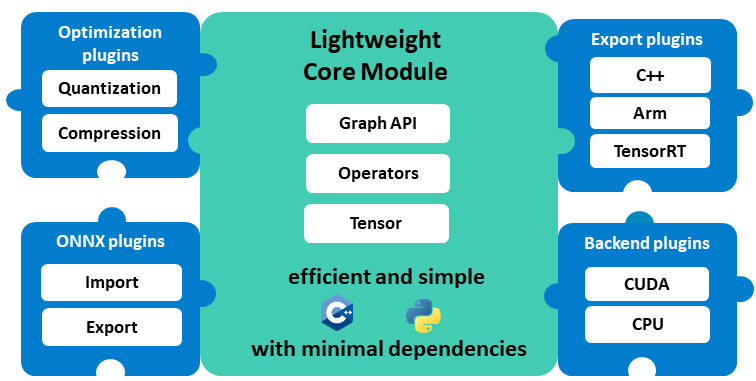
Module ecosystem overview#
Category |
Modules |
Description |
|---|---|---|
Core foundation |
|
The essential building blocks for manipulating AI models and data, indispensable for all other modules. |
Execution backends |
|
Enable Aidge to run on specific hardware devices like CPUs and NVIDIA GPUs, providing concrete implementations. |
Export modules |
|
Generate deployable code for various target environments, seamlessly integrating AI models into diverse systems. |
Optimization suite |
|
Offer advanced techniques to optimize AI models, reducing size, improving speed, and minimizing resource consumption. |
Interoperability layer |
|
Facilitate smooth interaction between Aidge and other popular AI frameworks (ONNX, PyTorch) for broad compatibility. |
Development tools |
|
Visualize and explore AI model architectures and data flow within Aidge for easier understanding and debugging. |